
.png)

A payment can have the right beneficiary, the right account and valid authorisation, and still fail because of something far less visible: the data telling the payment where to go. A Bank Identifier Code (BIC) may have changed after a merger, a local clearing code may no longer be recognised, or a branch identifier that was once correct may have become outdated by the time the payment is initiated.
These are not isolated exceptions. According to LexisNexis Risk Solutions, around one in seven global payments (15%) require additional enrichment, checking with the beneficiary or repair before they can be processed. Getting the recipient right is therefore only one part of getting a payment right.
Why Stale Bank Reference Data Is Breaking Your Payments
Bank reference data is constantly changing. BICs can be reassigned following mergers, correspondent banking relationships shift, and local clearing systems introduce or restructure their own code types. Yet the internal reference tables institutions rely on may not always be refreshed at the same pace.
The challenge becomes greater for banks and payment providers operating across multiple corridors. Different markets rely on different identifiers, from BICs and American Bankers Association (ABA) routing numbers to Bank State Branch (BSB) codes, sort codes and local branch codes, often maintained through separate data sources and update cycles.
When this information becomes stale, the result is more than a data quality issue. A routing problem can lead to a returned payment, delayed settlement, manual investigation, additional correspondent banking fees and a poor experience for both payer and payee. In each case, operations teams are left fixing a problem that could potentially have been identified before the payment moved.
Payee Verification Solves Only Part of the Payment Puzzle
The payments industry has increasingly invested in pre-payment controls that help answer an important question: are we paying the intended person or business? Payee verification helps institutions confirm that the recipient exists and that the account being paid belongs to them.
But even a successfully verified payee does not guarantee a successfully routed payment. Institutions also need to know whether the bank and routing information being used to reach that account is current and appropriate for the receiving market or scheme.
This creates two distinct pre-payment checks. Payee verification helps establish who is being paid, while bank reference data helps establish how the payment gets there. A payment can pass one check and still fail the other.
For institutions looking to improve payment success, both matter.
Move Routing Checks Before Payment Initiation
The further a routing problem travels through the payment chain, the more difficult and costly it can become to resolve. What begins as an outdated identifier can eventually mean a returned payment, a repair request, a delayed settlement or additional operational work to trace and correct the transaction.
Checking bank reference data earlier changes where that problem is handled. Instead of waiting for the receiving institution or payment rail to reject incorrect routing information, banks and payment providers can identify potential issues while the payment is still being prepared.
That is the gap IPID’s Bank Reference Data is designed to address.
Introducing Bank Reference Data: Real-Time Routing Code Verification
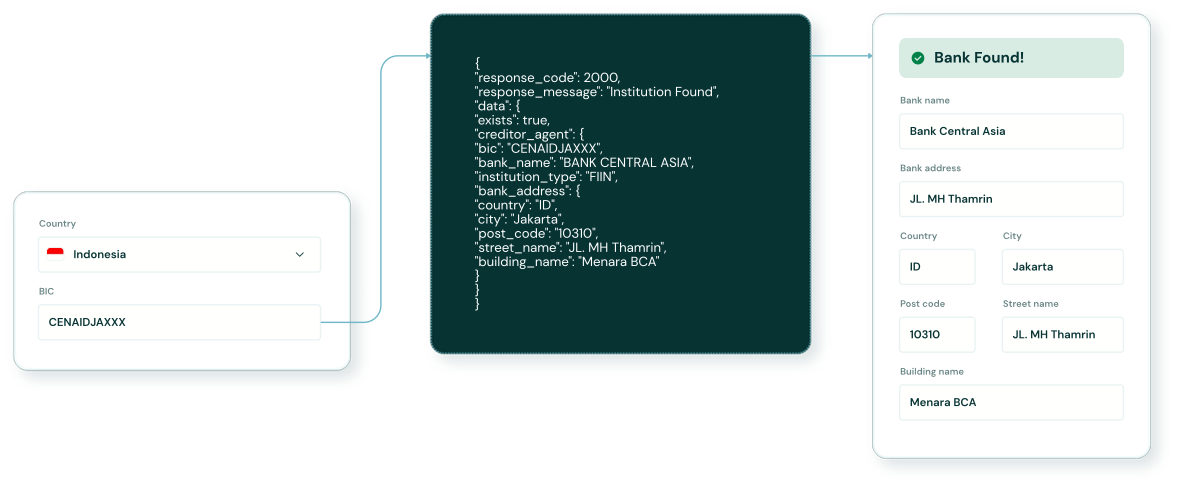
Bank Reference Data gives banks and payment providers access to current bank and routing code information across markets, helping them check payment routing details before funds move.
The service supports bank codes across multiple countries and payment schemes, covering both international and domestic routing requirements. As coverage expands, institutions can access a broader range of market-specific bank reference data through a single service.
For institutions operating across multiple corridors, this can reduce the need to maintain separate reference sources for different markets, each with its own coverage, gaps, and refresh cycles.
Bank Reference Data That Fits Existing Payment Flows
Institutions use reference data differently depending on how their payment infrastructure is built, so Bank Reference Data supports both live queries and dataset delivery.
For payment journeys that require information at the point of initiation, institutions can query individual bank codes through an API. This allows routing information to be checked as part of the payment flow rather than solely against a stored internal table.
For institutions that maintain their own reference databases, IPID can also provide a monthly export file via API. The dataset can be incorporated into existing internal processes, providing a way to keep local reference tables more current without introducing a completely different validation workflow.
Both approaches are designed to fit around how institutions already manage payment initiation, rather than requiring them to rebuild their processes around a new source of reference data.
Building a Broader Pre-Payment Layer: Verification + Routing
Bank Reference Data extends the types of payment issues that institutions can identify before initiation. Payee verification helps confirm the intended recipient, while Bank Reference Data helps check the routing information needed for the payment to reach them.
Together, these capabilities address different points of failure within the same payment journey. The objective is not simply to improve the quality of a reference database, but to move more checks upstream, before an avoidable issue becomes a returned payment, a repair case or a delayed settlement.
As payment flows become increasingly international and interconnected, successful payments depend on more than knowing who should receive the funds. Institutions also need confidence in the information that gets the payment there.
Bank Reference Data sits alongside IPID’s payee verification capabilities within the pre-payment layer, helping institutions check both the recipient and the route before a payment moves.
Learn how Bank Reference Data can help identify routing issues before they become payment failures.
References
- LexisNexis Risk Solutions - True Impact of Failed Payments Report (2023)


